Obesity has become one of the leading preventable causes of premature morbidity and mortality worldwide. In 2022, more than 390 million children and adolescents aged 5–19 years were overweight, and 160 million of them were obese.1 Children with obesity are at increased risk of type 2 diabetes, hypertension, dyslipidemia, and premature cardiovascular disease, and in 80% of adolescents, obesity persists into adulthood. The management of obesity is based on modifying eating and physical activity habits with a comprehensive approach that takes into account individual, family, and social factors. Although lifestyle interventions are the cornerstone of management, they achieve insufficient results, and there is growing interest in combining them with more aggressive strategies, including pharmacotherapy.
Pharmacological treatment of obesityHistorically, there have been weight-loss medications with very modest effects, such as orlistat, phentermine, and the phentermine/topiramate combination, as well as drugs used on an off-label basis, such as metformin. The major breakthrough in the pharmacological treatment of obesity, including in children, is the advent of incretin-based therapies, such as glucagon-like peptide-1 receptor analogs (GLP-1RAs). Originally developed for the treatment of type 2 diabetes, these drugs, which exert their therapeutic effects at multiple levels, have proven effective in reducing body weight and improving various obesity-related comorbidities.2
Glucagon-like peptide-1 receptor analogs modulate appetite and the control of blood sugar through their incretin-like effects. Glucagon-like peptide-1 is an incretin hormone released from intestinal L-cells in response to nutrient ingestion. It enhances insulin secretion, inhibits glucagon release, delays gastric emptying, reduces hepatic glucose production, reduces appetite, and promotes satiety, thereby contributing to improved glycemic control and weight loss. Currently, two GLP-1RAs are approved for the treatment of obesity in the pediatric population: liraglutide and semaglutide.
Liraglutide was the first to be distributed and is delivered in daily subcutaneous injections. It has been found to achieve a reduction in body weight compared to placebo, in addition to improvement of metabolic complications.3 In the SCALE Kids study, conducted in patients aged 6–12 years, 46% of the liraglutide group achieved a reduction in body mass index (BMI) of at least 5%. This drug is not the main option for adolescents and adults, as more effective molecules have become available; however, it continues to be an option to consider in children aged 6–12 years.
Semaglutide is a GLP-1RA developed through structural modifications that result in a marked prolongation of the half-life, allowing once-weekly subcutaneous administration. It has been found to have an improved effect on body weight and obesity complications. In the 68-week STEP TEENS trial, weekly administration of 2.4mg of semaglutide plus lifestyle intervention achieved a mean change in BMI of −16.1%. Seventy-three percent of patients on semaglutide achieved a weight loss of 5% or more, sixty-two percent of 10% or more, and fifty-three percent of 15% or more.4
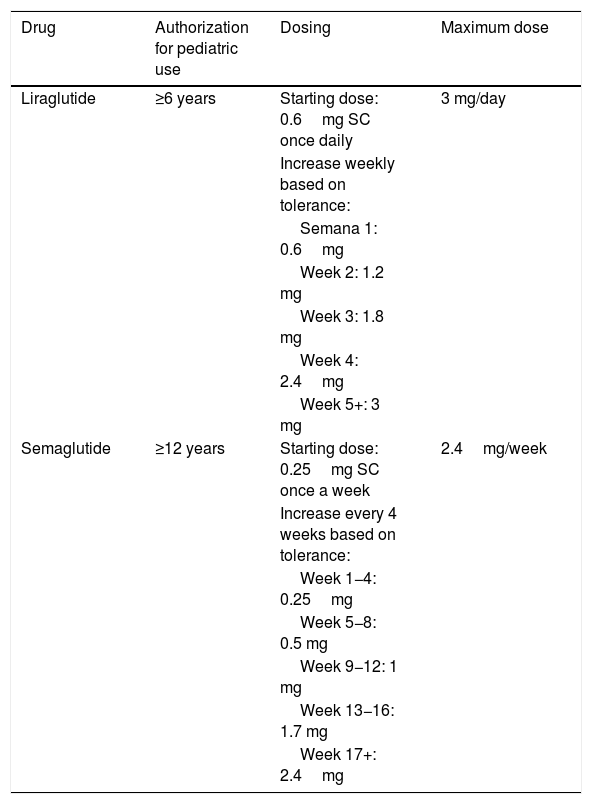
These drugs are authorized for treatment of obesity from age 6 years, in the case of liraglutide, and age 12 years, in the case of semaglutide. They are contraindicated during pregnancy and lactation, and in individuals with a personal or family history of medullary thyroid carcinoma or multiple endocrine neoplasia type 2 (MEN2). The most common adverse events are gastrointestinal, chiefly nausea, vomiting, and diarrhea, associated with delayed gastric emptying and central mechanisms. However, there is a low frequency of treatment discontinuation due to adverse effects, and tolerability improves substantially with a low initial dose and progressive dose escalation. Table 1 presents the dosing schedule for liraglutide and semaglutide. The current evidence indicates that these drugs are safe, and they do not seem to affect growth or pubertal development, although data from long-term studies are not yet available to confirm it.
Glucagon-like peptide-1 receptor agonists used to treat obesity in children and adolescents.
| Drug | Authorization for pediatric use | Dosing | Maximum dose |
|---|---|---|---|
| Liraglutide | ≥6 years | Starting dose: 0.6mg SC once daily | 3 mg/day |
| Increase weekly based on tolerance: | |||
| Semana 1: 0.6mg | |||
| Week 2: 1.2 mg | |||
| Week 3: 1.8 mg | |||
| Week 4: 2.4mg | |||
| Week 5+: 3 mg | |||
| Semaglutide | ≥12 years | Starting dose: 0.25mg SC once a week | 2.4mg/week |
| Increase every 4 weeks based on tolerance: | |||
| Week 1−4: 0.25mg | |||
| Week 5−8: 0.5 mg | |||
| Week 9−12: 1 mg | |||
| Week 13−16: 1.7 mg | |||
| Week 17+: 2.4mg |
In clinical practice, the dosing is individualized based on response and tolerability, with frequent use of doses lower than those administered in clinical trials. There are limited real-world efficacy data on these strategies. Weight loss is most pronounced during the first 6 months of treatment, after which it plateaus.
Treatment should be discontinued in the case of poor tolerance despite dose escalation or absence of a therapeutic response (weight loss of less than 5% after 16 weeks at the maximum tolerated dose).
An important consideration is the evidence of a rebound effect after treatment is discontinued, which raises many questions about its cessation.
It is also worth noting the effect of GLP-1RAs not only on obesity, but also in improving associated cardiometabolic complications.
Multiple clinical trials are currently underway investigating new incretin-based molecules, notably dual agonists such as tirzepatide, which is already available for adults. These combinations of 2, 3, and even 4 molecules with synergistic effects can achieve greater benefits.
Considerations and future challengesDespite advances in pharmacological treatments, lifestyle therapy remains the cornerstone of treatment.
There is evidence that individuals treated with GLP-1RAs may be at increased risk of nutritional deficiencies and loss of lean body mass.5 Given the early and more intense satiety, it is recommended to adjust portion sizes without skipping main meals. To manage adverse effects like nausea, vomiting, or constipation, it is recommended to eat small, frequent meals with a higher fiber intake, while ensuring adequate fluid and protein intake. Therefore, dietary counseling is essential in GLP-1RA therapy.
Children and adolescents with obesity are at increased risk of psychosocial problems, such as low self-esteem, anxiety, depressive symptoms, or social isolation, as well as at high risk of disordered eating behaviors and eating disorders. It is essential to assess, monitor, and address the potential impact of any medication on these risks, with involvement of mental health professionals.
Despite the encouraging results, important challenges remain that require attention. These challenges include evaluating the long-term efficacy and safety and real-world effectiveness of these drugs and identifying predictors of treatment response to enable the individualization of treatment in terms of its initiation, dosage, and duration, as well as tapering strategies. It is also important to define treatment goals beyond body weight, such as body composition outcomes and the impact on physical functioning and quality of life. The most appropriate dietary and physical activity recommendations and the optimal mental health support strategy need to be determined in order to achieve the best possible health outcomes. Furthermore, the lack of funding for these treatments in the public health care system poses a significant challenge in terms of accessibility and equity.
ConclusionsThere is an emerging therapeutic paradigm in the approach to the management of pediatric obesity in which pharmacological innovations complement interventions focused on acquiring and maintaining healthy habits, opening up promising avenues to pursue the desired goals of treatment. A balanced diet, regular physical activity, and behavioral support should continue to be the cornerstone of treatment. Continued, high-quality research must be pursued to strengthen the body of evidence, optimize the integration of these novel resources in clinical practice, and provide safe and effective interventions for the pediatric population.
PMG has received fees as a presenter in conferences from Medtronic.
LSO has received fees as a scientific consultant from Sanofi, and fees as a presenter in conferences from Novo Nordisk, Sandoz and Sanofi.
MRK has received fees as a scientific consultant from Novo Nordisk, Palobiofarma, Pfizer, Sandoz and Sanofi, and fees as a presenter in conferences from Novo Nordisk, Pfizer, Rhythm and Sandoz.