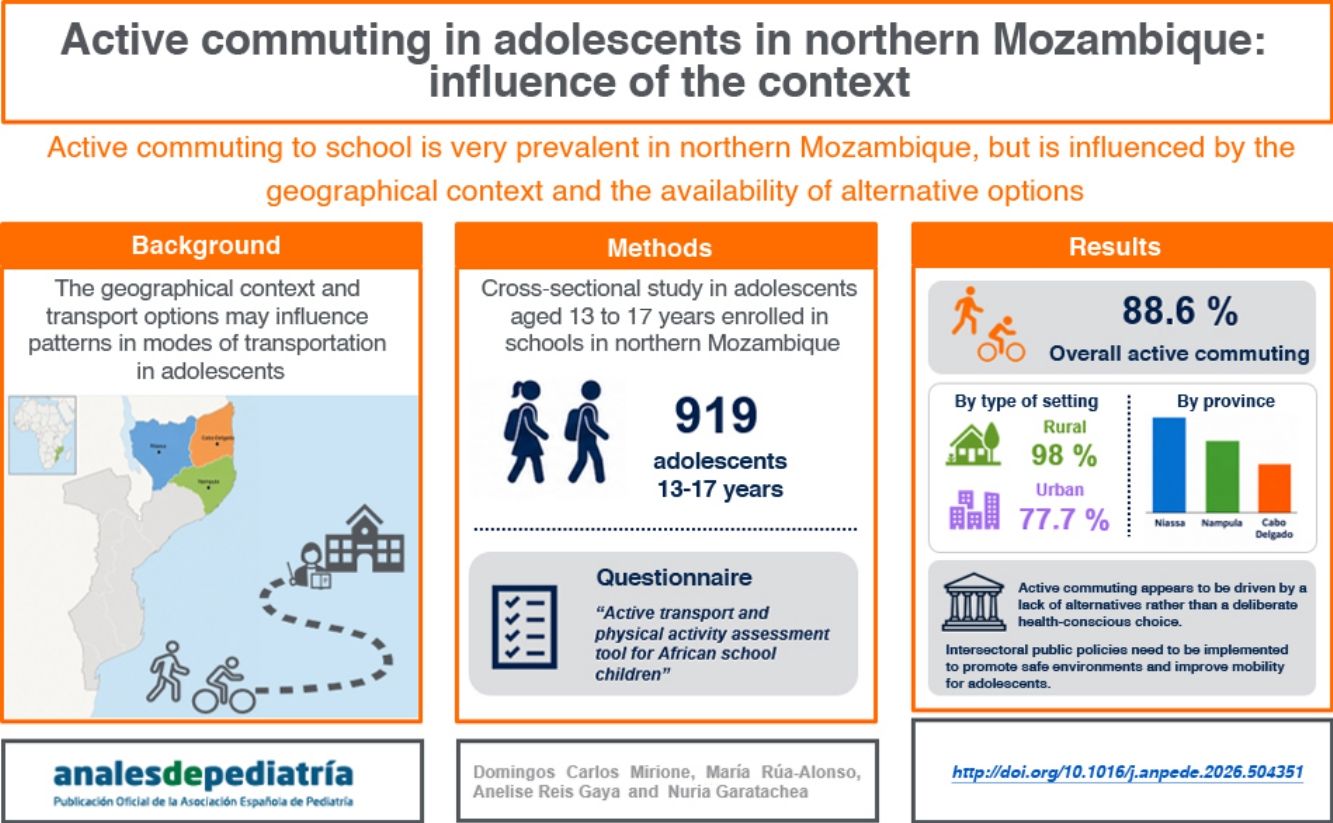
Active commuting to school is one of the most effective and cost-efficient strategies for increasing physical activity levels and advancing toward the recommendations for physical activity in adolescents of the World Health Organization.
MethodsThis study analyzed the prevalence of active commuting to school among adolescents in northern Mozambique in relation to sex, age, and area of residence (province and type of setting) through the administration of the Active Transport and Physical Activity Assessment Tool for African School Children questionnaire to 919 adolescents aged 13–17 from the provinces of Nampula, Cabo Delgado, and Niassa.
ResultsOverall, 88.6% of adolescents actively commuted to school (either on foot or by bicycle), with no significant differences by sex or age. However, there were variations based on place of residence, with a prevalence of 98% in rural areas compared to 77.7% in urban areas; Niassa had the highest rates of active commuting compared to the other provinces.
DiscussionActive commuting is the most common mode of travel to school among adolescents in northern Mozambique, although this appears to be driven more by a lack of alternatives than by a deliberate health-conscious choice. Therefore, it is imperative that authorities design intersectoral public policies to promote safe environments and improve travel conditions for adolescents in northern Mozambique.
El desplazamiento activo a la escuela es una de las estrategias más eficaces y económicas para aumentar los niveles de actividad física y acercarse a las recomendaciones de la Organización Mundial de la Salud para la actividad física en adolescentes.
MétodosEste estudio analizó la prevalencia del desplazamiento activo a la escuela en adolescentes del norte de Mozambique, en función del sexo, la edad y la zona de residencia (provincia y tipo de área) mediante la aplicación del cuestionario Active Transport and Physical Activity Assessment Tool for African School Children a 919 adolescentes de entre 13 y 17 años de las provincias de Nampula, Cabo Delgado y Niassa.
ResultadosEl 88,6% de los adolescentes se desplaza de forma activa a la escuela (ya sea a pie o en bicicleta), sin diferencias significativas según sexo o edad. No obstante, se observaron variaciones según la residencia, siendo la prevalencia del 98% en las zonas rurales frente al 77,7% de las zonas urbanas; la provincia de Niassa fue la que presentó mayores tasas de desplazamiento activo en comparación con las otras provincias.
DiscusionesEl desplazamiento activo a la escuela es el modo más utilizado por los adolescentes del norte de Mozambique, aunque este parece estar condicionado por la carencia de alternativas más que por una elección deliberada de salud. Por tanto, es crucial que las autoridades diseñen políticas públicas intersectoriales que promuevan entornos seguros y mejoren las condiciones de movilidad de la población adolescente de la región norte de Mozambique.
The increasing levels of physical inactivity, along with their implications for public health and the high associated economic costs,1 have sparked growing concern in both the general public and health authorities, prompting the development of various strategies to promote physical activity.2 Among them, active commuting (for instance, walking or cycling) has been identified as an accessible and sustainable option for increasing daily levels of physical activity among the general population and adolescents in particular.3,4 Furthermore, beyond its health benefits, active commuting offers additional advantages from an environmental and economic perspective, as it is considered a sustainable and eco-friendly mode of travel that helps reduce environmental pollution.5
In this regard, active commuting to school can have a particularly significant impact during adolescence, as it is a daily and recurring behavior that provides a systematic opportunity for this subset of the population to engage in regular physical activity.6,7 However, the available data indicate that its effects are not uniform and may vary depending on contextual factors. In particular, there is evidence suggesting that it may have a negative impact on academic performance in situations where adolescents need to travel long distances to get to school.8–10
On the other hand, the determinants of active commuting to school differ substantially depending on the socioeconomic context. In middle- and high-income countries, this behavior is typically linked to voluntary decisions associated with healthy lifestyles, whereas in low-income countries, it is largely driven by necessity and a lack of alternative options.11 In rural settings, absence of school transportation services and insufficient means to use private motor vehicles contribute to the adoption of active commuting, even among families that may have access to those resources, since their use may not be sustainable for daily commuting due to the associated costs, such as fuel.10 In urban settings, the cost of public transportation (especially for families with several school-aged children), in addition to inadequate or unreliable transportation infrastructures, also limits access to motorized transportation options, making active commuting the only option to travel to and from school.12 In light of this, it would be reasonable to expect a high prevalence of active commuting to school in certain areas. However, international evidence shows a downward trend in this behavior over the past few decades,13,14 highlighting the need to systematically monitor its evolution in different geographical settings. Furthermore, the evidence continues to be skewed toward middle- and high-income countries, while populations in the Global South remain underrepresented in research on physical activity and fitness,15 which underscores the need to generate evidence in diverse contexts.
In sub-Saharan Africa, and particularly in Mozambique, these dynamics take on an added layer of complexity. In these regions, where malnutrition is still widespread,16 the daily commute to school, especially when it involves long distances, could place an additional physiological burden on adolescents. In the specific case of Mozambique, studies on the prevalence of active commuting to school among adolescents are limited and focus primarily on the southern region of the country, and particularly on the city and province of Maputo.11,17 In contrast, there is virtually no evidence for the north, a region characterized by high levels of poverty, armed conflict, chronic malnutrition, and child labor.18–21
For this reason, the objective of our study was to analyze the prevalence of active commuting to school among adolescents in northern Mozambique and its distribution by sex, age, province, and classification of place of residence (urban vs rural).
MethodsParticipantsWe conducted a study in adolescents enrolled in secondary schools in the northern provinces of Mozambique (Nampula, Cabo Delgado, and Niassa), who participated on a voluntary basis. The sample was selected by multistage sampling, choosing the capital as the urban area in each province, along with a nonmunicipal rural district in the same province as the rural area. Subsequently, one school was randomly selected in each of these locations, and all students in grades 8 through 10 were invited to participate.
All participants met the inclusion criteria: age 13–17 years, and written consent to participation from their parents or legal guardians. Adolescents who reported feeling any pain or discomfort on the day of data collection were excluded.
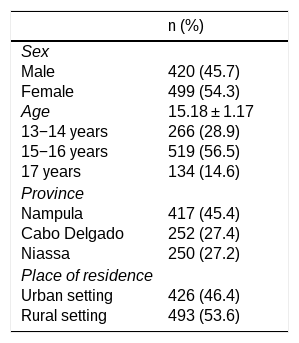
The final sample consisted of 919 adolescents, 499 female and 420 male, with a mean age of 15.18 years (SD, 1.17). The distribution of participants by province was 417 from Nampula, 252 from Cabo Delgado, and 250 from Niassa; 493 were from rural areas and 426 from urban areas.
The study was approved by the Scientific Directorate of Rovuma University (reference No. 163/DC/UniRovuma/2023) and was conducted in adherence to the principles of the Declaration of Helsinki. We obtained written informed consent from school principals and parents or legal guardians, as well as assent from the adolescents, prior to their participation.
ProtocolTo assess the mode of transportation used to commute to school, we used the Active Transport and Physical Activity Assessment Tool for African School Children questionnaire, which has been validated for use in Africa.22 Although the questionnaire validation study included a sample of the Mozambican population, we chose to conduct a pretest in 30 adolescents due to the significant cultural differences of Mozambique in order to minimize potential response biases. This led to the elimination of one item about distance from the questionnaire, as none of the participants knew the distance in kilometers between their home and school.
Data collection was conducted in classrooms by a team of researchers, faculty members, and students from the Sports Training and Physical Exercise Research Unit at the University of Rovuma. All members of the team received prior training on the standardized administration of the questionnaire, as well as on ethical practices to protect the participants and safeguard the confidentiality of their responses. Anonymity, privacy, and voluntary participation were guaranteed during the completion of the questionnaire, ensuring that the students understood they could refrain from answering any items without repercussions.
The operational definition of active commuting was walking or biking to school. Motorized modes of transportation, including private cars, buses, or motorcycles, were categorized as “passive or non-active commuting”. This classification allowed us to clearly differentiate active behaviors from those in which physical activity was absent or minimal, facilitating the analysis of the association between the type of commute and the levels of physical activity in the adolescent population under study.
Data analysisThe prevalence of active commuting was estimated using absolute and relative frequencies (%). We used the Pearson χ2 test to explore the association between the independent variables “province” (Nampula, Cabo Delgado, Niassa) and “type of setting” (rural/urban) and the practice of active commuting, defined as a dichotomous variable (yes/no). In addition, we calculated odds ratios (ORs) with the corresponding 95% confidence intervals (CIs) by logistic regression adjusted for sex, age group, province, and type of setting to calculate the probability of active commuting. In the analyses, we used the following as reference categories: Nampula for the province variable, urban for the type of setting/place of residence variable, the 13−14 years age group for the age variable, and male sex for the sex variable.
The statistical analyses were performed with the software IBM SPSS Statistics version 20.0 (IBM Corp; Armonk, NY, USA). We considered P values of less than .05 statistically significant.
ResultsTable 1 summarizes the sociodemographic characteristics of the participants.
Sociodemographic characteristics of the sample.
| n (%) | |
|---|---|
| Sex | |
| Male | 420 (45.7) |
| Female | 499 (54.3) |
| Age | 15.18 ± 1.17 |
| 13−14 years | 266 (28.9) |
| 15−16 years | 519 (56.5) |
| 17 years | 134 (14.6) |
| Province | |
| Nampula | 417 (45.4) |
| Cabo Delgado | 252 (27.4) |
| Niassa | 250 (27.2) |
| Place of residence | |
| Urban setting | 426 (46.4) |
| Rural setting | 493 (53.6) |
Data expressed as n (%) or mean ± SD.
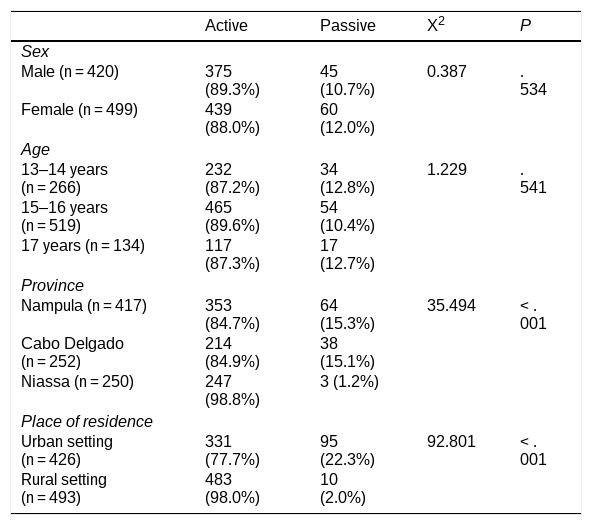
Overall, 88.6% of adolescents actively commuted to school, while 11.4% used passive transportation. Active commuting was the predominant mode, independently of sex and age, and there were no statistically significant differences based on sex (χ2 = 0.387; P = .534) or age group (χ2 = 1.229; P = .541) (Table 2).
Prevalence of active commuting to school in relation to sociodemographic characteristics (sex, age, province, and type of setting).
| Active | Passive | Χ2 | P | |
|---|---|---|---|---|
| Sex | ||||
| Male (n = 420) | 375 (89.3%) | 45 (10.7%) | 0.387 | .534 |
| Female (n = 499) | 439 (88.0%) | 60 (12.0%) | ||
| Age | ||||
| 13–14 years (n = 266) | 232 (87.2%) | 34 (12.8%) | 1.229 | .541 |
| 15–16 years (n = 519) | 465 (89.6%) | 54 (10.4%) | ||
| 17 years (n = 134) | 117 (87.3%) | 17 (12.7%) | ||
| Province | ||||
| Nampula (n = 417) | 353 (84.7%) | 64 (15.3%) | 35.494 | < .001 |
| Cabo Delgado (n = 252) | 214 (84.9%) | 38 (15.1%) | ||
| Niassa (n = 250) | 247 (98.8%) | 3 (1.2%) | ||
| Place of residence | ||||
| Urban setting (n = 426) | 331 (77.7%) | 95 (22.3%) | 92.801 | < .001 |
| Rural setting (n = 493) | 483 (98.0%) | 10 (2.0%) | ||
Data expressed as n (%).
With regard to geographical factors, there were statistically significant differences in the prevalence of active commuting based on the province (χ2 = 35.494; P < .001) and the type of setting (urban vs rural: χ2 = 92.801; P < .001). The highest prevalence corresponded to Niassa province (98.8%), and the prevalence was greater among adolescents living in rural areas compared to urban areas (98.0% vs 77.7%, respectively) (Table 2).
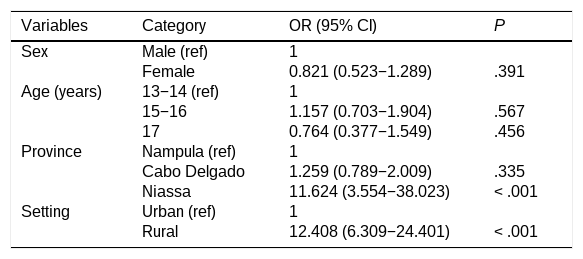
The results of the analysis based on the OR for active commuting to school (Table 3) showed a significant association with the province and the type of setting. Adolescents in Niassa province were significantly more likely to walk or cycle to school compared to those residing in Nampula province (OR = 11.624; 95% CI, 3.554−38.023; P < .001). Similarly, living in a rural setting was associated with a significantly greater probability of active commuting to school compared to residing in an urban setting (OR = 12.408; 95% CI, 6.309−24.401; P < .001).
Logistic regression adjusted for sex, age, province, and type of setting.
| Variables | Category | OR (95% CI) | P |
|---|---|---|---|
| Sex | Male (ref) | 1 | |
| Female | 0.821 (0.523−1.289) | .391 | |
| Age (years) | 13−14 (ref) | 1 | |
| 15−16 | 1.157 (0.703−1.904) | .567 | |
| 17 | 0.764 (0.377−1.549) | .456 | |
| Province | Nampula (ref) | 1 | |
| Cabo Delgado | 1.259 (0.789−2.009) | .335 | |
| Niassa | 11.624 (3.554−38.023) | < .001 | |
| Setting | Urban (ref) | 1 | |
| Rural | 12.408 (6.309−24.401) | < .001 |
The objective of our study was to assess the prevalence of active commuting to school in adolescents residing in northern Mozambique, taking into account sex, age, province and type of setting (urban vs rural). We found a high prevalence (88.6%), which indicates that active commuting (walking or cycling) is the main mode of travel in this population. We did not find significant differences according to sex or age. On the other hand, the prevalence of active commuting varied by province and type of setting, with higher prevalences in Niassa province and rural settings.
Compared to international reports, in which the prevalence of active commuting to school varies from 40% to 70% in relation to the geographical and socioeconomic context,7,13,23 the figures obtained in northern Mozambique were exceptionally high. The prevalences described in the United States and several countries in Europe and Latin America are inferior to those observed in our study.23–27 In this regard, the high prevalences observed in this study highlight the unique circumstances of Mozambique compared to what is described in much of the international literature. Overall, our findings illustrate the influence of local, socioeconomic, environmental, and public policy factors on the choice of school commuting mode.
In this context, the high prevalence observed in northern Mozambique even exceeded the prevalence reported in previous studies conducted in the southern region (Maputo and Bobole), of 70.8%,11 which indicates that there are specific factors within the country that vary between regions and contribute to these trends. These differences may be related to particular socioeconomic and environmental conditions, such as the availability of motor vehicles, the distance between home and school, perceived safety, and access to public transport. In upper-middle- and high-income countries, the probability of active commuting decreases with increasing distance to school, motor vehicle ownership, and crime rate or perceived insecurity.28 In northern Mozambique, the high prevalence may be related to the low private motor vehicle ownership and limited public transport services, especially in rural areas and the province of Niassa.29 Even in rural families with greater purchasing power, bicycles are a viable alternative, since the use of motorcycles and cars entails difficulties in terms of purchase, maintenance, and fuel. Furthermore, these results are consistent with the hypothesis that, contrary to high-income countries, where active commuting is typically encouraged by policies promoting healthy lifestyles and active transportation,27,30 in Mozambique this behavior depends to a greater extent on the availability of alternative transport options and sociocultural factors.11
With regard to individual-level factors, we did not find significant differences based on sex, consistent with previous research conducted in sub-Saharan Africa.11 However, the available evidence is inconsistent. While some studies have found significant differences between male and female subjects,7,13,31,32 others have not.11,28,33 Similarly, age was not associated with the mode of travel in the sample under study, in agreement with previous findings in Kenya and Mozambique. However, in other regions, such as in Nigeria, and in high-income countries, there has been evidence of an association with age. In general, in these regions, there is a higher probability of passive commuting in younger adolescents due to parental concerns about safety.11,28 Overall, the evidence shows inconsistent commuting patterns, suggesting that neither sex nor age is determinant in the mode of commuting to school.
Conversely, we found that the place of residence, including both the province and residence in urban versus rural areas, played a decisive role in the mode of travel in our study. In rural areas, the lack of public transportation and low household vehicle ownership forced adolescents to walk or cycle to school, whereas in urban areas or provinces with greater economic resources, the availability of passive modes of transport offered alternatives that reduced the need for active commuting.31,34–36 These results underscore the importance of the geographical context and the availability of transportation options in the choice of mode of travel to school, suggesting that in the case of Africa, the availability of alternative forms of transportation may play a particularly significant role.
This situation is reflected in the high prevalence of active commuting observed in rural areas of northern Mozambique, which in some cases is close to 100%. For example, Wachira et al.11 reported that 100% of adolescents in rural settings and 99.1% of those residing in periurban areas actively commuted to school. In addition, rural households with some discretionary income tend to purchase bicycles, while the use of motorcycles is limited due to fuel costs. Census data from 2017 show that 1 444 838 households had bicycles in rural areas compared to 343 525 in urban areas, with bicycle ownership being more than four times greater in rural settings.29 Overall, our findings, combined with the previous literature, show that, beyond household socioeconomic status, the regional context and the availability of transportation are key determinants of active commuting.33,36 This trend could explain the higher prevalence observed in the province of Niassa compared to Nampula and Cabo Delgado, as it is the region with the least economic resources, most limited access to technology, and lowest proportion of household car ownership. In addition, the lack of urban public transport services, even in the capital of the province,29 limits alternative travel options and forces adolescents to walk due to the high cost of motorized transport. In contrast, in developed countries, active commuting tends to be more prevalent in urban areas compared to rural areas, probably due to built environments that facilitate walking or biking and measures to promote active travel, such as the “safe routes to school” or “walking school buses” programs implemented in Europe, Canada, the United States, and Australia.30
In summary, the high prevalence of active commuting among adolescents in northern Mozambique appears to be attributable to a combination of factors primarily associated with the place of residence. These findings differ from the trends observed in other countries, where engagement in active commuting depends more on physical activity promotion policies, health education, and conducive urban design. Although active commuting to school is one of the most effective and inexpensive options to increase physical activity levels and advance toward the levels recommended for adolescents by the WHO,2,7 in areas characterized by extreme poverty, common in many countries in sub-Saharan Africa, including Mozambique,21 the impact of active commuting to school may be different. In settings where the double burden of malnutrition is a growing problem and there is still a high prevalence of undernutrition16 and of child labor,18 especially in rural areas, prolonged active commutes may place additional physiological demands on adolescents with a potential deleterious impact on their wellbeing and academic performance, especially if the distance to school is considerable.37 In line with this interpretation, the findings of previous studies suggest that long commutes to school are associated with adverse effects on academic performance. Studies conducted in Tanzania and China have shown that longer commute times are associated with tardiness, absenteeism, decreased study times, and reduced sleep duration.8,10 Therefore, active commuting to school in low-income settings can have paradoxical effects, as this mode of travel can be beneficial or harmful depending on its intensity, the distance involved, and the conditions under which it occurs.
Last of all, there are some limitations to the study that need to be taken into account. Its cross-sectional design precluded the establishment of causality, and the selection of schools by convenience sampling limits the generalizability of the results. Furthermore, the use of self-reported data entails a risk of recall or social desirability bias. Finally, the lack of data on the distance and duration of the commute and the exertion involved in it limits the interpretation of the real impact of active commuting, so the results should be interpreted with caution.
From an applied perspective, these findings highlight the need to design intersectoral policies to promote active commuting without compromising the wellbeing of adolescents, chiefly by improving infrastructure, ensuring access to school transportation services, and taking local socioeconomic conditions into account. Furthermore, future longitudinal and multicenter studies including variables such as the distance and duration of the commute and the required physical exertion could enable a better understanding of the impact of active commuting on health and academic performance.
ConclusionOur study found a high prevalence of active commuting to school among adolescents in northern Mozambique. There were no differences according to sex or age, while the province and type of setting (residing in urban versus rural areas) were significantly associated with this behavior, with the highest prevalences observed in Niassa and in rural areas. These results highlight the importance of the geographical context in the distribution of active commuting in the adolescent population.
Declaration of Generative AI and AI-assisted technologies in the writing processThe authors declare that no generative AI tools were used in producing this manuscript.
FundingThis study was funded by the National Research Fund of Mozambique (Fundo Nacional de Investigação), which provided support for data collection. Domingos Carlos Mirione received partial financial support from Universidade Rovuma. María Rúa-Alonso received funding from the Xunta de Galicia (Consellería de Cultura, Educación, Formación Profesional y Universidades) through the Xunta de Galicia Postdoctoral Fellowships (ED481B-2024-077).
The authors declare having no conflicts of interest.
We want to express our sincere gratitude to the late Adroaldo Gaya for his invaluable support, and we take this opportunity to posthumously recognize his outstanding contributions to the fields of Physical Education and Sports Sciences.