In Spain, cow’s milk protein allergy (CMPA) is the second leading food allergy, following egg allergy. Currently, there is uncertainty as regards primary prevention strategies. Some studies have demonstrated that the use of extensively hydrolyzed formula (eHF) during the first days of life reduces the risk of sensitization.
ObjectivesTo determine whether early exposure to eHF reduces the risk of developing CMPA compared to the administration of infant formula (IF).
Material and methodsWe conducted a quasi-experimental before-and-after intervention study during the 2013 and 2018 periods. In 2018, the supplementation protocol was modified, replacing IF with eHF. We conducted a 2-year clinical follow-up, after which we collected the following data for patients for whom we received consent to participation: personal and family history of allergy, perinatal history, type of feeding received, and formula exposure.
ResultsWe observed a significant 67% reduction in the risk of CMPA in newborns exposed to eHF compared to IF (OR, 0.334; 95% CI, 0.174−0.643). Conversely, the risk increased 15.75-fold in patients who received supplementation with IF compared to exclusive breastfeeding (OR, 15.75; 95% CI, 3.81–65.03). The probability of developing CMPA increased in patients with a maternal history of allergy (OR, 3.56; P < 0.001), residing in rural settings (OR, 0.30; P < 0.001), or who had egg allergy (P < 0.001).
ConclusionsIn newborns belonging to high-risk populations who are breastfed, the use of eHF supplementation during the first days of life appears to be a reasonable strategy.
En España, la alergia a las proteínas de leche de vaca (APLV) supone la segunda causa de alergia alimentaria tras el huevo. Actualmente la prevención primaria no está bien establecida. Algunos estudios han demostrado que el uso de fórmulas extensamente hidrolizadas (FHe) en los primeros días de vida disminuye el riesgo de desarrollarla.
ObjetivosDeterminar si la exposición precoz a las FHe reduce el riesgo de APLV frente al uso de fórmulas de inicio (FI).
Material y métodosEstudio cuasi-experimental de intervención antes-después durante los periodos 2013 y 2018. En el 2018 se sustituyó el protocolo de suplementación cambiando las FI por FHe. Tras seguimiento clínico durante 2 años, se recogieron los datos de los pacientes que participaron voluntariamente: antecedentes personales y familiares de alergia, antecedentes perinatales, tipo de alimentación y suplementación.
ResultadosSe observó una reducción significativa del 67% del riesgo de APLV en los RN expuestos a FHe frente a los expuestos a FI (OR 0,334; IC95%: 0,174−0,643) y un aumento multiplicado por 15,75 en los expuestos a FI frente LME (OR 15,75; IC95%: 3,81−65,03). La posibilidad de APLV aumentaba cuando el paciente asociaba antecedentes maternos de alergia (OR 3,56; p < 0,001) domicilio familiar en un área rural (OR 0,30; p < 0,001) o presentaba alergia al huevo (p < 0,001).
ConclusionesEn aquellos RN que pertenezcan a poblaciones de riesgo y que reciban lactancia materna parece razonable el uso de suplementos con FHe durante los primeros días de vida.
Food allergies (FAs) have become one of the main medical challenges of the 21st century, with an exponential increase in both their prevalence and their most severe form (anaphylaxis) over the past two decades.1
Cow’s milk protein allergy (CMPA) is the allergy that is diagnosed earliest in childhood, as cow’s milk proteins (CMPs) are the first exogenous proteins that children are exposed to through the diet.2,3
At the global level, the European Academy of Allergy & Clinical Immunology (EAACI) estimates a prevalence of 3% to 10% in the pediatric population.1 When it comes to Spain, the most recent studies, such the EuroPrevall, have estimated a prevalence of CMPA of 0.7%4 and identified it as the second most frequent food allergy, following egg allergy.3,5,6
Cow’s milk protein allergy is characterized by an early onset, generally in the first year of life, and full spontaneous resolution in most patients by age 5 years.7,8 The pathogenesis of CMPA involves an abnormal immune response to dietary antigens (proteins) mediated by immunoglobulin E (IgE), non-IgE, or mixed mechanisms.9 This hypersensitivity reaction develops in genetically predisposed individuals in the context of certain environmental factors, such as the immaturity of the digestive tract or alterations in the intestinal microbiome,3,10 and it usually manifests in the first days of life following early exposure to food allergens, specifically CMPs.5,9
In recent years, the management of CMPA has shifted from a passive approach, consistent in the elimination of CMP (milk and dairy products) from the diet,11,12 to a proactive approach. The new clinical guidelines recommend replacing CMP with extensively hydrolyzed formulas (eHFs) with casein and whey hydrolysates or hydrolyzed rice formulas for first-line treatment of CMPA,12,13 in addition to personalized dietary and specific immunomodulatory interventions (such as allergen‐specific immunotherapy or biologics).1,13
Primary prevention in CMPA consists in preventing infants from becoming sensitized to CMP and encompasses any measures to be implemented before allergy develops.3 These include promotion of exclusive breastfeeding (EBF) through 4–6 months of life, early introduction of CMP with regular, usually daily, exposure during what is known as the window period (age 4–6 months, as complementary foods are first introduced), avoidance of sporadic exposure to CMP in the first week of life (in particular, isolated formula feedings administered by health care staff during the hospital stay outside an ongoing supplementation strategy), or, in select cases, use of eHF, for instance, to supplement BF during the first week of life in infants with atopic risk or in whom CMPA is suspected.14
Several studies have examined the hypothesis that avoiding direct exposure to CMP by substituting hydrolyzed proteins (which are less allergenic)15 in the first days of life could not only reduce the risk of CMPA, but also eliminate immunological memory in future stages.12,15 The aim of our study was to determine whether early exposure to eHFs in the first days of life was associated with a reduction in the incidence of CMPA in our setting compared to the administration of stage 1 infant formula (IF-S1).
Material and methodsStudy sampleAll infants born between January 1 and December 31, 2013 (control group) or January 1 and December 31, 2018 (intervention group) were eligible for inclusion in the study. A total of 3098 infants were born during these two periods.
We excluded all infants born preterm before 34 weeks of gestation, as they were considered a vulnerable group due to the differences in nutritional composition between the formulas used during the study. These infants accounted for 1.2% of all births (0.6% in each study period).
In preparation for the prospective phase of the study in 2018 (intervention), the infant formula supplementation protocol on the maternity ward was modified, replacing IF-S1 with casein- or whey-based eHF, once the study protocol was approved by the ethics committee of the hospital.
When the parents of the infants in the intervention cohort arrived at the ward, they were given a letter to inform them that a study was underway with the aim of minimizing the risk of future development of CMPA through the use of eHF. If a breastfed infant required supplementation with infant formula, an eHF would be used, whereas infants who were exclusively formula-fed (due to maternal preference or contraindication to EBF) would be provided with IF-S1 according to the brand rotation schedule of the hospital. Parents could refuse the use of eHF at any time during the stay.
The necessary formula supplements were prepared in the formula room of the pediatric ward before each feeding, and administered by the family (or, when the family could not do it, nurses and/or nurse assistants on staff) by syringe via the oral route.
All breastfed infants who received supplemental formula (mixed feeding) at the time discharge were given bottles of eHF to ensure supplementation per the study protocol until the first visit to the assigned primary care pediatrician at 7 days post birth to prevent dietary transgressions that could affect the results.
The follow-up consisted of one phone interview for controls in the 2013 cohort (retrospective data collection) and three phone interviews 7 days, 6 months, and 2 years after birth for the 2018 cohort.
The telephone interviews were conducted after receiving informed consent, with a 45% response rate in the 2013 cohort (52% refused to participate and 2% could not be located) and similar rates in the 2018 cohort (55% participated, 41% refused, and 3% could not be contacted).
The diagnosis of CMPA is based on the presence of compatible symptoms, specific allergy tests, the resolution of symptoms after elimination of CMP from the diet, and the recurrence of symptoms after the oral food challenge (OFC), which is considered the gold standard. In addition to analyzing what infants were fed and the incidence of CMPA, we analyzed demographic characteristics and the personal and family history of other allergies.
MethodsWe conducted a quasi-experimental pre-post intervention study to assess the efficacy of eHF compared to IF-S1 in the 2013 and 2018 cohorts.
For the 2013 cohort, data were collected through the review of health records and a telephone interview with the parents after they provided verbal inform consent. For the 2018 cohort, we collected data through clinical interviews conducted 7 days, 6 months and 2 years after birth.
The data for the study variables were entered and stored in a table and subsequently analyzed using MS Excel. To safeguard confidentiality, each subject was assigned an alphanumeric code so that their actual identities would only be known to the principal investigators through a master list.
We collected and analyzed the following data: date of birth, infant sex, type of delivery, prematurity, need of admission to the neonatal unit, family history of allergy and atopy, infant feeding modality (breastfeeding, mixed feeding [MF], or formula feeding [FF]), whether the infant received EBF or mixed feeding and its duration, administration of formula supplements during the hospital stay (IF-S1 vs eHF), development of CMPA and the date of onset and/or diagnosis (after evaluation by a pediatrician and/or allergy specialist), resolution of symptoms, and, finally, the development of other allergies during the study period (other FA, atopic dermatitis, bronchospasm, or rhinoconjunctivitis).
We conducted a univariate logistic regression analysis, using the χ2, Pearson, Student t and Mann-Whitney U tests. In the multivariate analysis, we used the Hosmer-Lemeshow goodness-of-fit test to assess the calibration of the model, which yielded a p value of 0.31 (not significant), although the Nagelkerke R2 was 0.095.
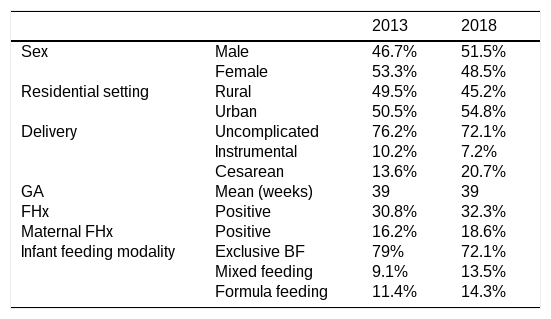
ResultsIn the 2013 period, EBF was the predominant infant feeding modality (79%), followed by FF (11.4%) and MF (9.1%). In 2018, the prevalence of EBF was lower (72.1%), with increases in FF (14.3%) and MF (13.5%). The differences in the distribution of infant feeding modalities between the two cohorts were not statistically significant (P = .916).
Ther was a 1.7% increase in the administration of supplements in the maternity ward in 2018 compared to 2013, without significant differences overall or by subgroup.
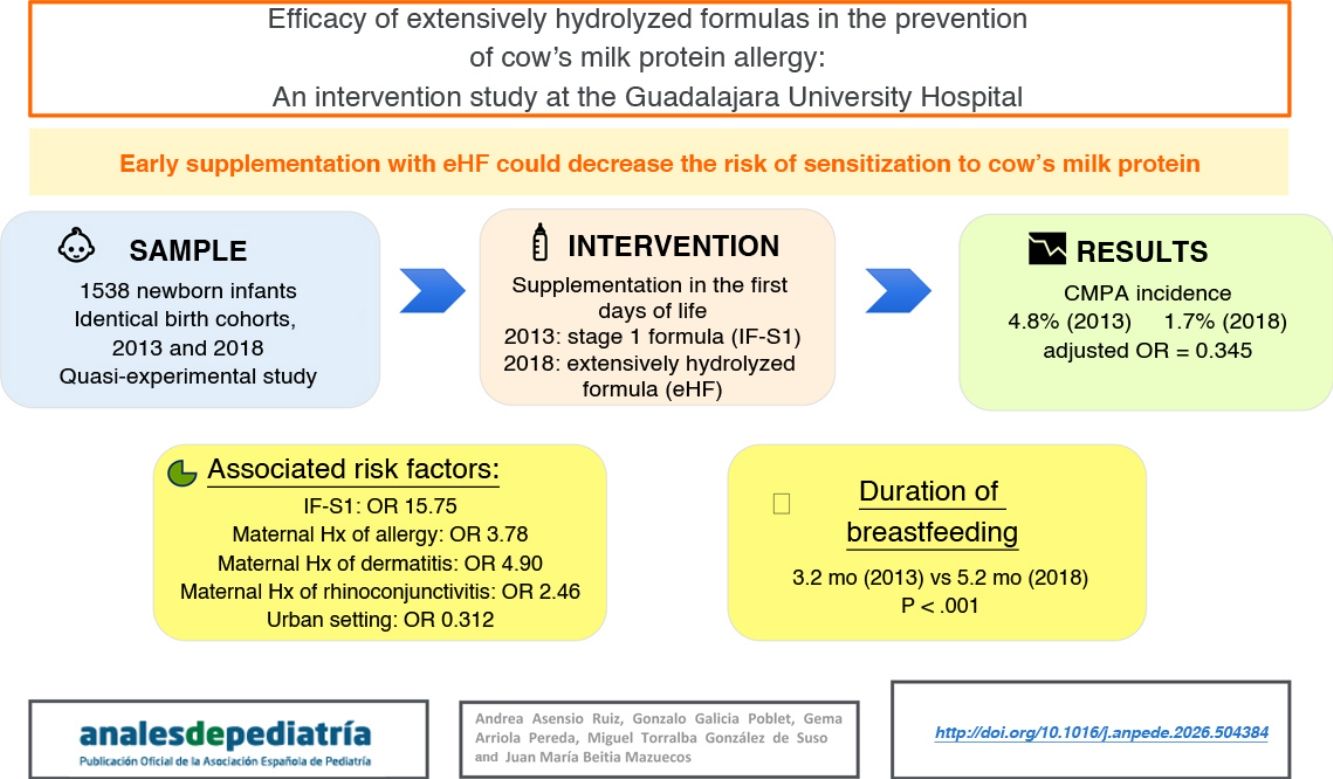
In our study, the incidence of CMPA was 4.8% in the 2013 cohort (39/813 infants), and decreased to 1.7% in the 2018 cohort (12/725 infants), a difference that was statistically significant (P < 0.001).
In the analysis stratified by infant feeding modality and type of supplement, we found a greater risk of CMPA in infants in the 2013 cohort who had received supplementation with IF-S1 during the hospital stay (OR, 29.49; 95% CI, 4.00–217.20). In the 2018 cohort, there was a modest increase in the risk of CMPA in the subgroup of infants with EBF or MF (breastfed with supplementation with eHF) compared to other groups (OR, 5.55; 0.66–46.45), but the difference was not statistically significant. In the MF subgroup, all cases of CMPA occurred in infants who had first been exposed to infant formula (IF-S1 or eHF) in the first days of life, both in 2013 (adjusted OR, 3.39; 95% CI, 0.17–68.39) and in 2018 (adjusted OR, 1.10; 95% CI, 0.05–23.95). In the FF subgroup, 3% of infants developed CMPA in both cohorts, without statistically significant differences between the two study periods (P = .820).
The distribution of IgE-mediated vs non-IgE-mediated cases was uniform in both periods (IgE-mediated: 43% in 2013 and 50% in 2018; non-IgE-mediated: 57% in 2013 and 50% in 2018).
The mean age at onset was 4.5 months. However, the onset was earlier in the 2018 cohort (mean age, 2 months [2018] vs 5 months [2013]; P < 0.001).
In terms of resolution, 88% of the patients achieved oral tolerance at a mean age of 12.7 months.
Among the factors associated with CMPA, a positive family history of allergy doubled the risk (OR, 2.2; P < 0.005). The risk increased with a maternal history of allergy (OR 3.56; P < 0.001), particularly with a maternal history of atopic dermatitis (OR 4.90; P < 0.001) or allergic rhinoconjunctivitis (OR, 2.46; P < 0.023). We did not find a significant association with a paternal or sibling history of allergy.
When it came to the residential setting, the risk of CMPA was 70% lower in infants residing in urban settings (OR, 0.30; P < 0.001) compared to rural settings.
Atopic dermatitis was found in 29.4% of the patients (P = 0.023), and there was a statistically significant association with the presence of egg allergy (P < 0.001). We did not find evidence of an association with the type of delivery (P = 0.46), preterm birth (P = 0.603), or admission to the neonatal unit (P = 0.33).
We analyzed whether EBF could have a protective effect against the development of CMPA compared to IF-S1 and found no significant differences (P = .820). The babies that developed CMPA received EBF for a mean of 3.20 months, while the duration of EBF in those who did not develop CMPA was two months longer (total duration, 5.17 months; P < 0.001).
In the multivariate analysis, receiving eHF in the first days of life was associated with a 67% reduction in the probability of CMPA (OR, 0.334; 95% CI, 0.174−0.643) compared to receiving IF-S1. On the other hand, we found that formula supplementation in the first days of life in infants that were subsequently exclusively breastfed was associated with a 15.75-fold increase in the risk of CMPA compared to infants who were exclusively breastfed from birth (OR, 15.75; 95% CI, 3.81–65.03), and this increase was greater in the subset who received supplementation with IF-S1 before continuing EBF (OR, 29.49; 95% CI, 4.00–217.20).
Multivariate analysisThe logistic regression model confirmed that the use of eHF was independently associated with a 65.5% reduction in the risk of CMPA (OR, 0.345; 95% CI, 0.178−0.670), even after adjusting for residential setting, family history, and infant feeding modality. Residing in an urban setting (OR, 0.312; 0.166−0.585) and a maternal history of allergy (OR, 3.78; 2.102–6.814) remained significantly and independently associated with the development of CMPA.
DiscussionOur study found a consistent association between supplementation with IF-S1 and the development of CMPA compared to supplementation with eHF, especially in infants who received occasional supplementation in the first days of life and were exclusively breastfed thereafter.
The selection of the historic cohort of 2013, which is neither concurrent nor consecutive with the intervention cohort, was warranted due to the institutional stability over the intervening period, as there were no changes in the care team, the nutrition protocols (save for the substitution of eHF for IF-S1 in the intervention period), nor the criteria for diagnosis of CMPA. This allowed us to isolate the effect of the intervention, avoiding biases associated with interobserver variability, and provided a washout period before the intervention (Table 1).
Comparison of the selected cohorts.
| 2013 | 2018 | ||
|---|---|---|---|
| Sex | Male | 46.7% | 51.5% |
| Female | 53.3% | 48.5% | |
| Residential setting | Rural | 49.5% | 45.2% |
| Urban | 50.5% | 54.8% | |
| Delivery | Uncomplicated | 76.2% | 72.1% |
| Instrumental | 10.2% | 7.2% | |
| Cesarean | 13.6% | 20.7% | |
| GA | Mean (weeks) | 39 | 39 |
| FHx | Positive | 30.8% | 32.3% |
| Maternal FHx | Positive | 16.2% | 18.6% |
| Infant feeding modality | Exclusive BF | 79% | 72.1% |
| Mixed feeding | 9.1% | 13.5% | |
| Formula feeding | 11.4% | 14.3% |
Abbreviations: FHx, family history; GA, gestational age.
The main finding of the study was that the frequency of CMPA decreased significantly after the introduction of eHF (4.8% vs 1.7%). In addition, the magnitude of the association between supplementation with IF-S1 and CMPA was significantly greater in the 2013 cohort, with a statistically significant association in the EBF + IF-S1 subgroup.
The findings in the 2013 cohort strongly support the hypothesis of the sporadic formula feedings by health care staff initially proposed by Host et al.7 and subsequently confirmed by Saarinen et al. in a prospective cohort study in more than 6000 infants,16 which found an increased risk of CMPA in breastfed children who were exposed to CMP sporadically in the first days of life. Later on, there have been clinical trials, like the one conducted by Urashima et al.17 (cited by the ESPGHAN in its position papers12) that demonstrated that avoiding supplementation with IF-S1 in the first few days post birth significantly reduced the development of sensitization to cow’s milk and of CMPA during childhood.17,18
The observed associations with a maternal history of atopy and residence in a rural setting support the multifactorial etiology of CMPA, in which genetic predisposition, combined with early environmental exposures that can modulate the development of the immune system (such as those described in relation to the so-called farm effect) could play a key role.19,20
In recent years, scientific societies have conducted reviews on the primary prevention of CMPA and its potential modifiable risk factors.21 As concerns exposure to eHFs, the most recent guidelines of the EAACI (2023)1 state that a recommendation for or against their use for primary prevention of CMPA cannot be issued on account of the low quality and heterogeneity of currently available studies.
When it comes to the earlier onset of CMPA in the 2018 cohort, a possible explanation is that the use of eHF could reduce the risk of CMPA in infants who are less genetically predisposed while selecting those with a greater intrinsic predisposition, which would account for the earlier onset.22,23
To conclude, the main findings of our study—the decreased incidence of CMPA with the use of eHF and the fact that the strongest association with CMPA corresponded to the group of otherwise exclusively breastfed infants who received supplementation with IF-S1—contribute additional evidence in support of the hypothesis that early and sporadic exposures to CMP could play a key role in the immune sensitization that leads to the development of CMPA, which would justify the use of eHF in patients at risk in the first few days of life.
LimitationsThe historical cohort of controls was not managed in a period concurrent or consecutive with the intervention, which carries a risk of bias associated with changing temporal trends. We attempted to minimize these risks by selecting an identical cohort and ensuring that organizational variables had remained unchanged in the intervening period.
The telephone interviews to collect data for the control group were conducted once the intervention had been planned, so there is a risk of recall bias. This risk is reduced because patients who developed CMPA were evaluated in the gastroenterology and/or allergy clinics at the onset of symptoms, which involved the documentation of data corresponding to the key study variables.
Last of all, since the study was conducted in a single center with a low incidence of CMPA, despite the significance of the main findings, it is important to be cautious as regards their external validity.
ConclusionsSupplementation with IF-S1 was significantly associated with an increased risk of CMPA, and the association was particularly strong in infants who continued to be exclusively breastfed thereafter.
The duration of exclusive or mixed breastfeeding was significantly and inversely associated with the risk of CMPA.
These findings are consistent with current recommendations from scientific societies to promote EBF for the first few months and avoid unnecessary supplementation for the first few days of life.
In newborn infants who belong to risk groups and who are exclusively breastfed, it seems reasonable to use eHF if supplementation is needed in the first few days of life in order to reduce the risk of sensitization to CMP.
FundingThis research project did not receive specific financial support from funding agencies in the public, private or not-for-profit sectors.
Declaration of Generative AI and AI-assisted technologies in the writing processThe authors declare that no generative AI or AI-assisted technologies were used in the writing process.
The authors have no conflicts of interest to declare.