
Type 1 diabetes (T1D) can be identified in preclinical stages through the detection of islet autoantibodies and staged before clinical onset. This evolving paradigm highlights the need for structured care models allowing coordinated identification, staging, and follow-up of individuals with positive islet autoimmunity. This document describes an Integrated Care Pathway (ICP) developed from the available scientific evidence and the national SED-SEEN-SEEP consensus on screening and monitoring of preclinical T1D. The model is organised into three core sub-processes (target population identification, autoantibody detection and confirmation, and clinical follow-up with staging) and one transversal support sub-process based on information systems and performance indicators. This ICP provides a structured, evaluable, and scalable framework for the homogeneous implementation of screening and follow-up of preclinical T1D.
La diabetes tipo 1 (DT1) puede identificarse en fases preclínicas mediante la detección de autoanticuerpos frente a antígenos de la célula beta y clasificarse antes del debut clínico. Este nuevo escenario plantea la necesidad de modelos asistenciales estructurados que permitan la identificación, estadificación y seguimiento coordinado de las personas con autoinmunidad positiva. El presente documento describe un Proceso Asistencial Integrado (PAI), desarrollado a partir de la evidencia científica disponible y del consenso nacional SED-SEEN-SEEP sobre cribado y seguimiento de la DT1 preclínica. El modelo se organiza en tres subprocesos nucleares (identificación de población diana, detección y confirmación de autoanticuerpos y seguimiento clínico con estadificación) y un subproceso transversal de soporte basado en sistemas de información y evaluación mediante indicadores. Este PAI proporciona un marco estructurado, evaluable y escalable para la implementación homogénea del cribado y seguimiento de la DT1 en estadios preclínicos.
Type 1 diabetes mellitus (T1DM) is an autoimmune disease characterized by the progressive destruction of pancreatic beta cells, resulting in absolute insulin deficiency.1 Traditionally, diagnosis has been based on the detection of hyperglycemia with or without symptoms; however, current evidence indicates that T1DM is a continuous biological process that can be identified several years before clinical onset.1–3 The persistent presence of two or more autoantibodies against beta-cell antigens defines a presymptomatic phase with a high risk of progression to clinical diabetes. Classification into stage 1 (normoglycemia), stage 2 (dysglycemia), and stage 3 (clinical diabetes) has been internationally validated and adopted by scientific societies such as the International Society for Pediatric and Adolescent Diabetes (ISPAD) and the American Diabetes Association (ADA).1,4,5
Several studies have shown that participation in structured follow-up programs during preclinical stages significantly reduces the incidence of diabetic ketoacidosis at diagnosis,6–8 a complication associated with subsequent difficulty in achieving glycemic targets.2 It also allows therapeutic education to be initiated in advance and clinical follow-up to be planned in a structured manner from the early stages.6
In this context, identifying individuals at risk and following them during preclinical stages highlight the need to define clear, coordinated care pathways across levels of care. Variability in clinical practice and the absence of structured organizational models may hinder the consistent implementation of available recommendations. To address this need, an Integrated Care Pathway (ICP) is proposed to standardize the identification, diagnostic confirmation, staging, and follow-up of T1DM in preclinical stages, integrating clinical, organizational, educational, and evaluative dimensions into a single operational model. This model is based on the national consensus document on “Screening, staging, and follow-up of type 1 diabetes in preclinical stages,” developed by Sociedad Española de Diabetes (SED), Sociedad Española de Endocrinología y Nutrición (SEEN), and Sociedad Española de Endocrinología Pediátrica (SEEP).8
ObjectiveThe aim of this document is to describe an ICP for the screening, staging, and follow-up of T1DM in preclinical stages, aligned with international recommendations and adapted to the organizational context of health care. It also seeks to provide a coherent organizational proposal integrating scientific, educational, and process-management dimensions.
Scientific rationale for screeningFirst-degree relatives (FDRs) of individuals with T1DM have a 10–15-fold higher risk than the general population,4,9 making them the main target group for screening in clinical practice. However, approximately 90% of new T1DM cases are diagnosed in individuals with no family history,4,6 which has prompted the development of pilot screening studies in the general population.
From a methodological perspective, T1DM screening can be approached using 2 main strategies: one based on direct autoantibody detection and another combining an initial assessment of genetic risk with subsequent autoantibody testing in high-risk individuals. The usefulness of genetic markers (HLA and polygenic risk scores) has been widely described.4,6,10 However, the available evidence supports the determination of autoantibodies against beta-cell antigens (GADA, IA-2A, IAA, and ZnT8A) as fundamental markers of pancreatic beta-cell autoimmunity1,4,5,11 and as the basis for identifying T1DM in preclinical stages.
At present, screening FDRs or individuals with a known high genetic risk is the strategy supported by the available clinical evidence and aligned with recommendations from scientific societies and international consensus statements.8 This approach supports the development of structured screening programs integrated into care models with defined pathways and indicator-based evaluation.
Process boundariesEntry criteriaThe process is initiated through 2 pathways: 1) first-degree relatives of individuals with T1DM within the established age ranges: children and adolescents (2–18 years) and adults (18–45 years),4,6,9 and 2) individuals with a known high genetic risk, identified through high-risk HLA alleles or polygenic risk scores (PRS/GRS).4,6,10
Screening is indicated after structured information has been provided and informed consent obtained, while respecting the ethical principles of autonomy and the right not to know.1,10
Exit criteriaIndividuals exit the process in the event of persistent absence of autoimmunity after protocolized follow-up,4,9 by voluntary decision of the patient or legal guardians,1 or upon progression to stage 3, with structured referral to the clinical T1D care pathway within their health care setting or system.1,4,8
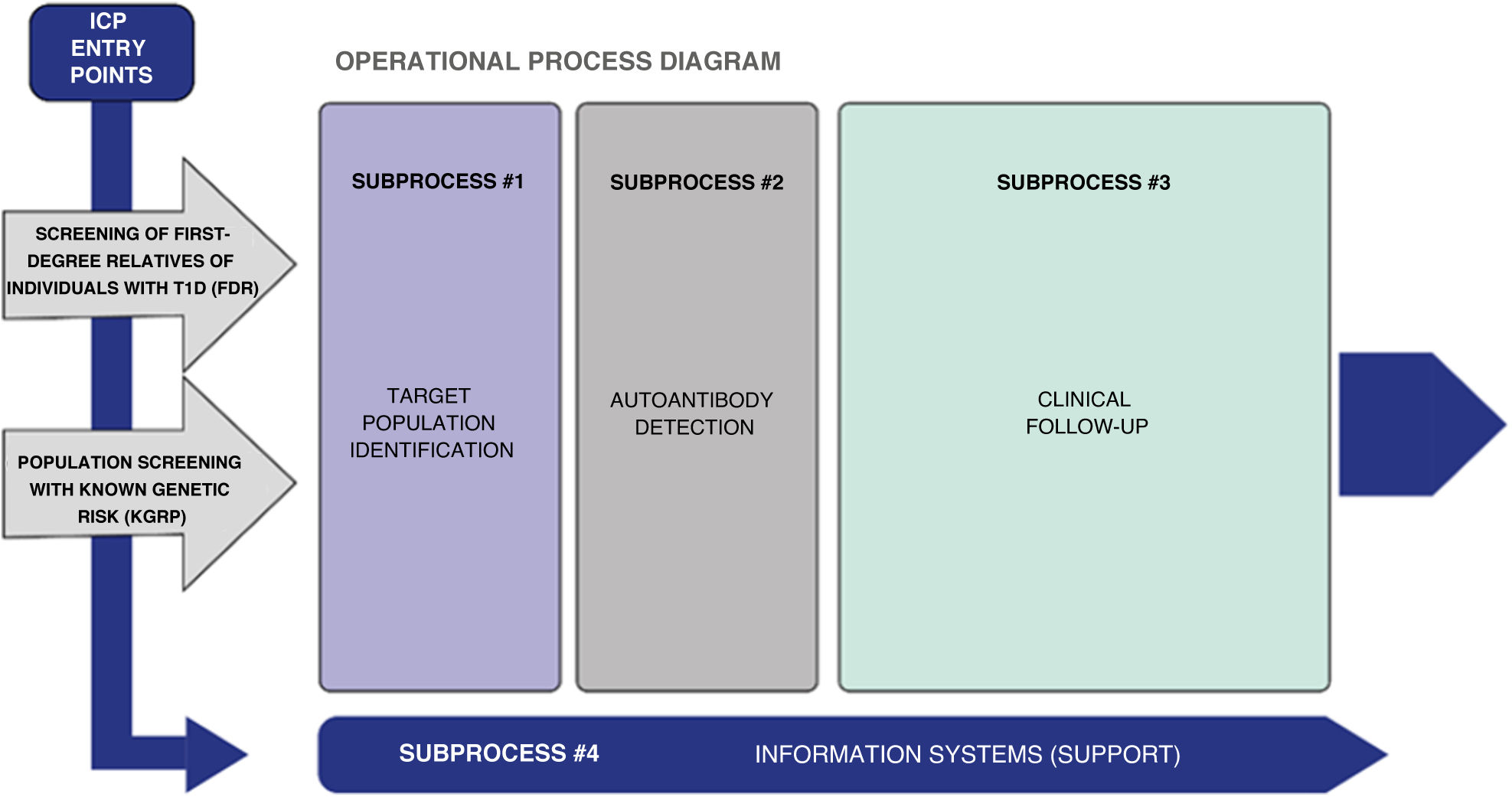
General process structureThe ICP is organized into 3 core subprocesses and one cross-cutting support subprocess (Fig. 1), with explicit definition of responsible professionals, activities, quality requirements, and indicators, which are described in detail in the original document available as supplementary data (Appendix A).

The first ICP subprocess involves the systematic identification of individuals eligible for immunological screening. This phase is based on structured review of electronic health records, registration of index T1DM cases, and active recruitment of first-degree relatives within the established age ranges, as well as individuals with previously identified high genetic risk. This strategy is based on the significantly higher risk among FDRs compared with the general population4,9,12 and on the ability of genetic stratification using HLA or polygenic risk scores to improve the identification of susceptible individuals.7,13
Activation of the process includes the creation of dedicated appointment schedules, the definition of internal communication pathways between primary and hospital care, and coordination between levels of care to ensure accessibility and equity, in accordance with international recommendations for the structured follow-up of individuals with positive autoimmunity.4,5,9 Inclusion requires informed consent and provision of structured explanatory documentation enabling individuals to understand the meaning of screening, its possible results, and the associated clinical implications, while respecting the principles of autonomy and the right not to know.1
This subprocess ensures consistency in inclusion criteria, traceability of clinical decisions, and structured recording of all interventions, thereby providing the organizational foundation on which the remainder of the model is built.
Subprocess #2. Autoantibody detection and confirmationSubprocess #2 focuses on immunological detection using a standardized panel that includes beta-cell autoantibodies (GADA, IA-2A, ZnT8A, and IAA), whose diagnostic utility and predictive value are well documented.1,2,10 Testing is performed in accredited laboratories using validated methodologies in accordance with international analytical quality standards, as sensitivity and specificity vary according to the technique used.14
Following a positive result, the protocol establishes confirmation using a second sample, preferably with an alternative methodology when available, in order to minimize false-positive results and strengthen diagnostic validity, in full compliance with consensus recommendations for the management of individuals with positive autoantibodies.4,9 Results are communicated according to a structured procedure that ensures clear information and appropriate clinical support.9
This subprocess defines the timing and frequency of antibody testing for each age group. Accordingly, individuals without evidence of autoimmunity may require repeat testing or may exit the process, depending on the established protocol. Confirmation of autoimmunity immediately activates the clinical follow-up subprocess, allowing an organized transition to structured monitoring consistent with the internationally accepted staging classification.1
Subprocess #3. Clinical follow-up and stagingSubprocess #3 constitutes the core clinical component of the ICP and aims to monitor the clinical course of individuals with confirmed autoimmunity. It includes a comprehensive initial clinical assessment, HbA1c measurement and oral glucose tolerance testing according to protocol, and assignment of the corresponding stage according to current ADA criteria5 and the internationally recognized staging model.1
The frequency of follow-up is adapted according to age, number and type of autoantibodies, and disease stage, all of which influence the likelihood of progression to stage 3.2,7,12,13 Structured follow-up enables early detection of clinical progression, reducing the likelihood of stage 3 diagnosis during a metabolic emergency. Several studies have shown that participation in preclinical follow-up programs significantly reduces the frequency of clinical onset with diabetic ketoacidosis (DKA),7,11 a complication associated with poorer long-term metabolic control.11
The model incorporates the Therapeutic Care and Education Program (TCEP) as a structured component and a central pillar of the process. The program addresses understanding of the autoimmune process, early recognition of symptoms of progression, prevention of DKA, adoption of healthy lifestyle habits, and emotional coping, in accordance with international standards for promoting healthy behaviors and psychosocial well-being.15,16 Progression to stage 3 activates structured referral to the clinical T1DM care pathway within the individual’s health care setting, ensuring continuity of care and avoiding discontinuities in management.
Similarly, early identification facilitates potential participation in clinical trials or immunomodulatory strategies that have demonstrated the ability to delay progression in certain settings.17,18
Subprocess #4. Information and evaluation systemSubprocess #4 is cross-cutting and supports the overall architecture of the model through an integrated information system. This system enables structured recording of activities, generation of automatic alerts at relevant clinical milestones, and continuous monitoring of performance indicators, in accordance with international recommendations for systematic monitoring of individuals with positive autoimmunity.2,4,9
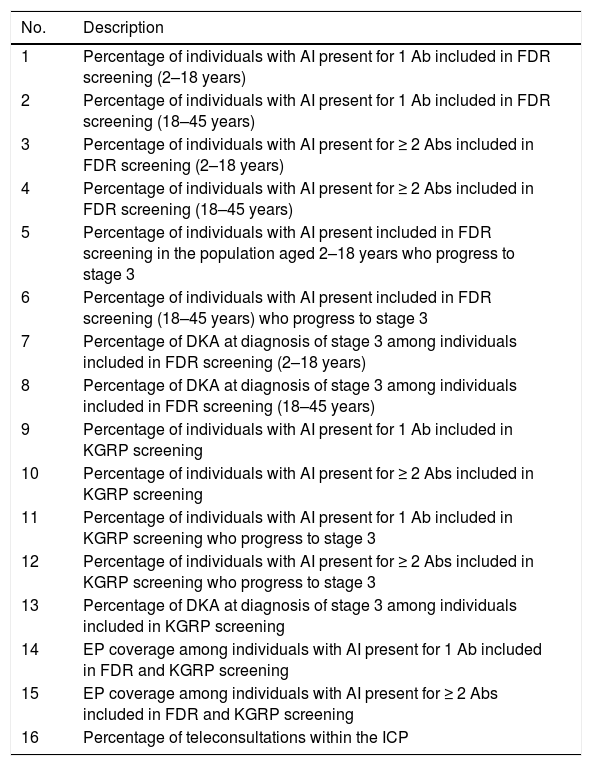
A set of 16 indicators was defined (Table 1) to evaluate screening performance among first-degree relatives and individuals with genetic risk, the rate of progression to stage 3—whose natural history has been extensively described in prospective cohorts—2,7,13 the incidence of DKA as the form of presentation at stage 3,7,11 coverage of the educational program,16 and the use of teleconsultation. These indicators can be used to construct a dashboard that facilitates continuous evaluation, comparative analysis across regions, and identification of areas for optimization, thereby strengthening a data-driven continuous improvement model focused on clinically relevant outcomes and consistent with international strategies for screening and structured follow-up.15,16
Indicators for monitoring the Integrated Care Pathway (ICP).
| No. | Description |
|---|---|
| 1 | Percentage of individuals with AI present for 1 Ab included in FDR screening (2–18 years) |
| 2 | Percentage of individuals with AI present for 1 Ab included in FDR screening (18–45 years) |
| 3 | Percentage of individuals with AI present for ≥ 2 Abs included in FDR screening (2–18 years) |
| 4 | Percentage of individuals with AI present for ≥ 2 Abs included in FDR screening (18–45 years) |
| 5 | Percentage of individuals with AI present included in FDR screening in the population aged 2–18 years who progress to stage 3 |
| 6 | Percentage of individuals with AI present included in FDR screening (18–45 years) who progress to stage 3 |
| 7 | Percentage of DKA at diagnosis of stage 3 among individuals included in FDR screening (2–18 years) |
| 8 | Percentage of DKA at diagnosis of stage 3 among individuals included in FDR screening (18–45 years) |
| 9 | Percentage of individuals with AI present for 1 Ab included in KGRP screening |
| 10 | Percentage of individuals with AI present for ≥ 2 Abs included in KGRP screening |
| 11 | Percentage of individuals with AI present for 1 Ab included in KGRP screening who progress to stage 3 |
| 12 | Percentage of individuals with AI present for ≥ 2 Abs included in KGRP screening who progress to stage 3 |
| 13 | Percentage of DKA at diagnosis of stage 3 among individuals included in KGRP screening |
| 14 | EP coverage among individuals with AI present for 1 Ab included in FDR and KGRP screening |
| 15 | EP coverage among individuals with AI present for ≥ 2 Abs included in FDR and KGRP screening |
| 16 | Percentage of teleconsultations within the ICP |
Ab, antibody; AI, autoimmunity; DKA, diabetic ketoacidosis; FDR, first-degree relatives; KGRP, population with known genetic risk; EP, Educational Program.
Integration of the information system ensures traceability, management transparency, and the long-term sustainability of the ICP.
Key recommendations- •
Implementation of the ICP should be adapted to the organizational structure of each Health Service, ensuring coordination between primary and hospital care.
- •
A specific training plan for the professionals involved should be designed before screening is implemented.
- •
Standardized methods and accredited laboratories for autoantibody determination and confirmation are essential.
- •
Follow-up of individuals with confirmed autoimmunity should be protocolized and multidisciplinary and should include structured therapeutic education and psychological support when necessary.
- •
The development of pilot population-screening programs is recommended to assess predictive performance, feasibility, and cost-effectiveness within the context of the National Health System.
This ICP provides a structured, evaluable, and scalable framework for the early identification and management of T1DM in preclinical stages, incorporating protocolized analytical confirmation, accredited laboratories, structured follow-up, integration of therapeutic education, continuity of care, and systematic indicator-based evaluation. It is conceived as a dynamic model aligned with the available scientific evidence and national consensus recommendations, whose implementation should ensure genuine follow-up capacity, ethical standards, and organizational quality. Standardization of these care pathways could facilitate future coordinated strategies for screening and follow-up of T1DM in preclinical stages within the Spanish National Health System.
CRediT authorship contribution statementAll authors participated in the conception, drafting, critical review, and final approval of the manuscript. The coordinating group supervised the methodological and editorial consistency of the document.
FundingThis document was developed with the support of Sanofi Spain. The content was prepared independently by the authors, as representatives of the participating scientific societies, without involvement of the funder in the interpretation of the evidence or in the conclusions.
ALGG has received honoraria and/or funding for educational activities and participation in congresses from Sanofi, Novo Nordisk, and Sandoz, and participates in research projects funded by Sanofi and Lilly. FGP has participated in advisory meetings for Dexcom, Abbott Diabetes, Novartis, AstraZeneca, Sanofi, Insulcloud S.L., and Novo Nordisk; has served as principal investigator in clinical trials funded by Sanofi, Novo Nordisk, Boehringer Ingelheim Pharmaceuticals, and Lilly; and has served as a speaker for Abbott Diabetes, Novartis, Sanofi, Novo Nordisk, Boehringer Ingelheim Pharmaceuticals, AstraZeneca Pharmaceuticals LP, Bristol-Myers Squibb Co., and Lilly. SPM has received honoraria from Sanofi (for lectures and as an expert involved in the preparation of materials) and Novalab (expert collaboration in the preparation of materials). VB has received honoraria for lectures, advisory activities, or research projects from Abbott, AstraZeneca, Bayer, Boehringer Ingelheim, Eli Lilly, Esteve, MSD, Novalab, Novo Nordisk, and Sanofi. RCH is principal investigator in studies sponsored by Diamyd Medical AB, Novartis, and Sanofi, and has received honoraria for lectures or scientific advisory activities from Abbott, Dexcom, Medtronic, Novo Nordisk, and Sanofi. MAMB is principal investigator in studies sponsored by Diamyd Medical AB, Sanofi, and SAB Biotherapeutics and has participated in paid activities (lectures or scientific advisory work) for Novo Nordisk and Sanofi. The author declares no conflicts of interest related to the preparation of this document.
The following is Supplementary data to this article:

This article has been produced jointly by «Endocrinología, Diabetes y Nutrición», «Endocrinología, Diabetes y Nutrición» (English edition), «Anales de Pediatría» and «Anales de Pediatría» (English edition), and published jointly by Elsevier España S.L.U. The articles are identical, apart from minor stylistic and spelling differences, in accordance with the style of each journal. Either of the two references may be used to cite this article.