
We thank Xavier Bosch-Capblanch1 for his interest in our work and for providing the opportunity to qualify certain aspects of our review,2 aimed at the updating of the Family Digital Plan (FDP).3 Regarding the use of devices during childhood, it should be noted that the potential benefits of educational games are limited to controlled experimental settings, such as the one described in the article by the Canadian Paediatric Society, which the author interprets out of the general context.4 In the real-world setting, screen use among children under 5 is typically passive, displacing physical play and interactions that are essential for neurodevelopment.
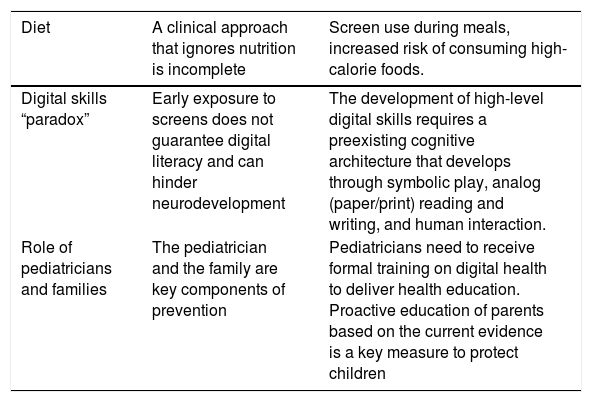
Guided by the precautionary principle5 in the face of documented risks, we agree with positions such as the one by the Karolinska Institutet,6 which highlights the lack of evidence of clear benefits of the digitalization of education in the school system compared to the use of conventional tools of proven effectiveness. We uphold our opinion that the critical factor is the total screen time, which displaces healthy habits, and consider that addressing each type of device separately would lessen the effectiveness of prevention strategies. We would also like to comment on the mentioned “paradox” regarding digital skill acquisition: early exposure to digital devices does not guarantee acquisition of digital skills and can hinder development, as higher cognitive functions develop from a foundation built on human interactions and symbolic play. The global guidelines of the FDP (Table 1) aim to offer integral protection from the public health system and are founded on the proactive education of families and the preventive role of pediatricians in mitigating the negative impact of the displacement effect in the absence of demonstrated benefits.
Rationale of recommendations.
| Diet | A clinical approach that ignores nutrition is incomplete | Screen use during meals, increased risk of consuming high-calorie foods. |
|---|---|---|
| Digital skills “paradox” | Early exposure to screens does not guarantee digital literacy and can hinder neurodevelopment | The development of high-level digital skills requires a preexisting cognitive architecture that develops through symbolic play, analog (paper/print) reading and writing, and human interaction. |
| Role of pediatricians and families | The pediatrician and the family are key components of prevention | Pediatricians need to receive formal training on digital health to deliver health education. Proactive education of parents based on the current evidence is a key measure to protect children |
This work did not involve participation of any patients or human subjects.
FundingThis research did not receive any external funding.
The authors have no conflicts of interest to declare.