The editorial published in Anales de Pediatría with the title “Beyond wounds: the persistent impact of armed conflicts on child health. Defending the right of every child to a safe environment, clean water and psychological protection is not taking sides”1 reflects the authors’ and the journal’s concern with humanitarian pediatrics. The editorial highlights the importance of raising awareness and defending children’s rights in situations of extreme vulnerability, such as armed conflicts (ACs).
One of the challenges in quantifying the impact of ACs on child health is the lack of reliable records for monitoring and reporting incidents. To address this, the United Nations (UN) publishes an annual report on “Children and Armed Conflict”,2 which provides country-by-country data on the six grave violations against children’s rights in the context of ACs3:
- 1
Killing and maiming of children
- 2
Recruitment or use of children in armed forces and armed groups
- 3
Attacks against schools or hospitals
- 4
Rape or other grave sexual violence
- 5
Abduction of children
- 6
Denial of humanitarian access for children
These estimates are obtained through a strict protocol for fact-checking on the ground designed to ensure that every piece of reported data constitutes legally sound evidence. This methodology is based on the Monitoring and Reporting Mechanism, established by Resolution 1612 (2005),4 which serves as the operational core for the systematic collection of data on grave violations against children in situations of armed conflict. The protocol sets a rigorous standard for evidence collection based on mandatory triangulation: each incident is only considered verified when it is confirmed by at least two other different and independent sources. Monitors and partners maintain individual case records with unique identifiers, ensuring that each case can be traced. Information is collected through an extensive network of sources, including UN personnel, local health care networks, and nongovernmental organizations. Information from these sources is cross-checked before it is included in official reports.
Because of the stringent requirements for eyewitness testimony or documentary evidence, the UN itself explicitly acknowledges in the description of its methodology that the reported figures are minimum estimates. In situations involving a complete collapse of telecommunications, the bombing of hospitals, or significant obstruction of humanitarian access imposed by parties to the conflict, many actual cases cannot be formally verified and are therefore excluded from official statistics.
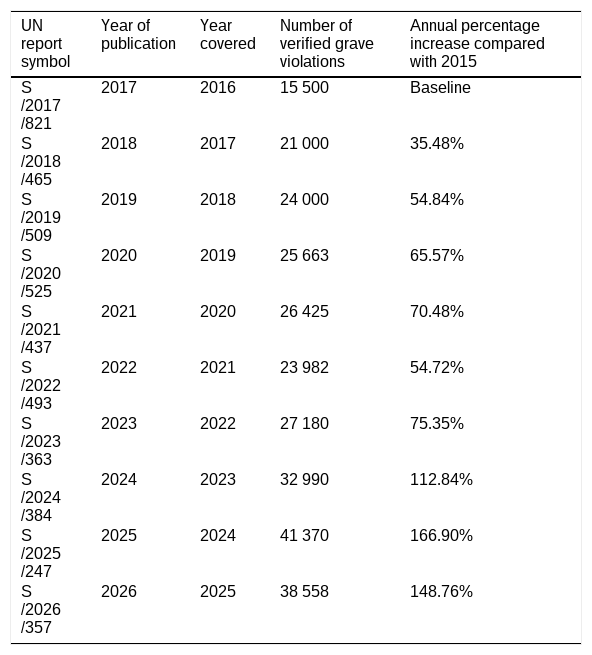
Table 1 shows the temporal trends observed in the total 276 668 grave violations included in the UN reports of the past 10 years. The progressive increase in grave violations in the past decade—especially given the underestimation of total cases—is alarming. The number of cases in the past two years is 2.5 times greater compared to 2015.
Verified grave violations against children affected by armed conflict over the past 10 years.
| UN report symbol | Year of publication | Year covered | Number of verified grave violations | Annual percentage increase compared with 2015 |
|---|---|---|---|---|
| S/2017/821 | 2017 | 2016 | 15 500 | Baseline |
| S/2018/465 | 2018 | 2017 | 21 000 | 35.48% |
| S/2019/509 | 2019 | 2018 | 24 000 | 54.84% |
| S/2020/525 | 2020 | 2019 | 25 663 | 65.57% |
| S/2021/437 | 2021 | 2020 | 26 425 | 70.48% |
| S/2022/493 | 2022 | 2021 | 23 982 | 54.72% |
| S/2023/363 | 2023 | 2022 | 27 180 | 75.35% |
| S/2024/384 | 2024 | 2023 | 32 990 | 112.84% |
| S/2025/247 | 2025 | 2024 | 41 370 | 166.90% |
| S/2026/357 | 2026 | 2025 | 38 558 | 148.76% |
These data help estimate the magnitude of the direct and severe impact of ACs on child health, as well as its unfavorable trend over time, which warrants the subtitle of the cited editorial.
FundingThis research did not receive any external funding.
The authors have no conflicts of interest to declare.