
Sugerencias
Idioma
Información de la revista
Vol. 105. Núm. 2.
(Agosto 2026)
Cita
Cita
Compartir
Descargar PDF
Más opciones de artículo
Vol. 105. Núm. 2.
(Agosto 2026)
Images in Paediatrics
Acceso a texto completo

Early recognition of neonatal herpes simplex virus infection: The significance of vesicular lesions

Reconocimiento precoz de la infección por virus del herpes simple en un recién nacido: importancia de las lesiones vesiculosas
Visitas
752
Ana Paola Jiménez Jiménez
Autor para correspondencia
doctorajimenez2012@hotmail.es

Corresponding author.
, Noemí Muñoz Quesada, Pilar Ranchal Pérez, Zineb Al Kalii El Moussaoui
Servicio de Pediatría, Unidad de Neonatología, Hospital Universitario Costa del Sol, Marbella, Málaga, Spain
Este artículo ha recibido
Información del artículo
Texto completo
Bibliografía
Descargar PDF
Estadísticas
Figuras (2)
fig0005
fig0010
Texto completo

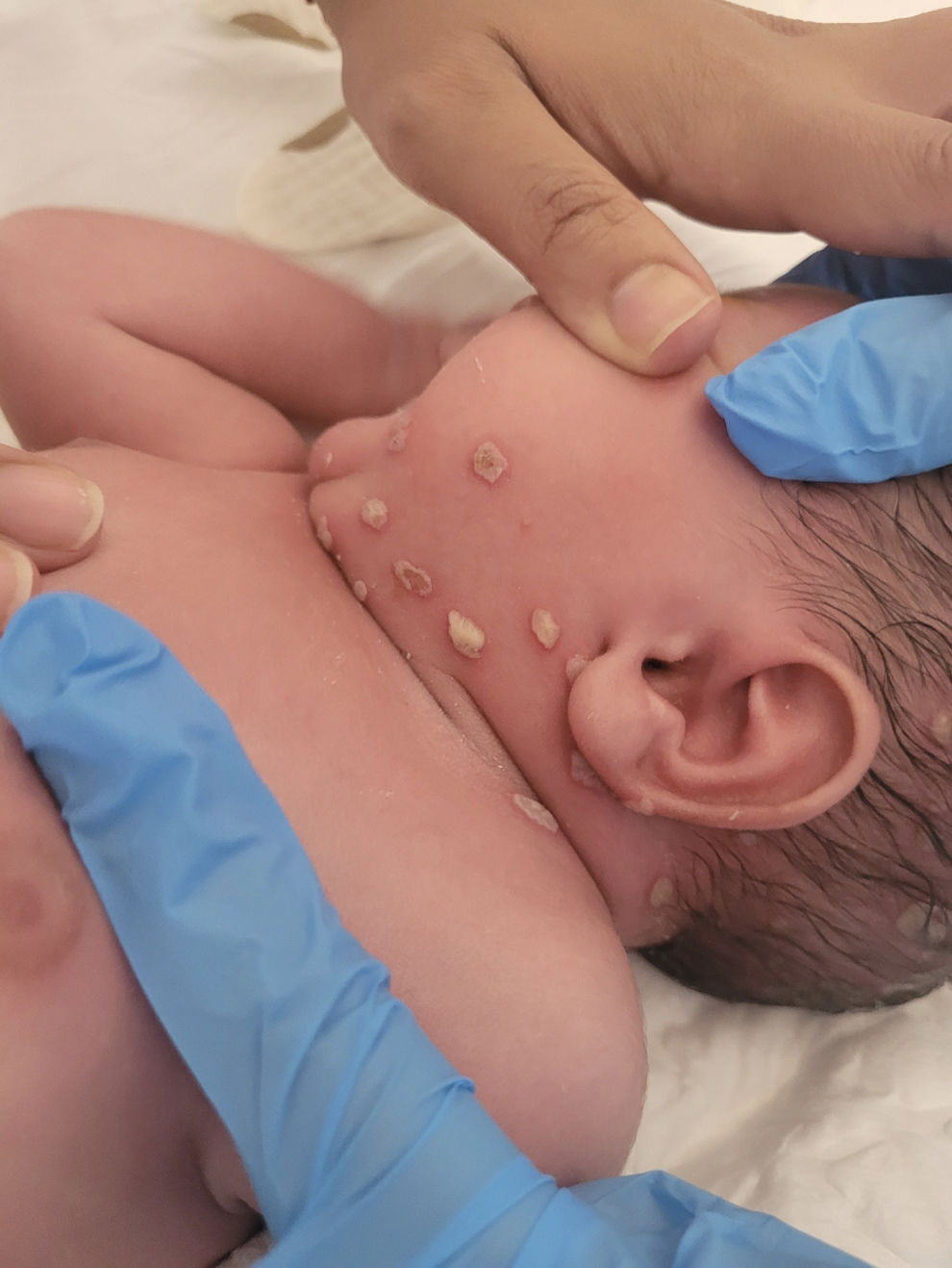
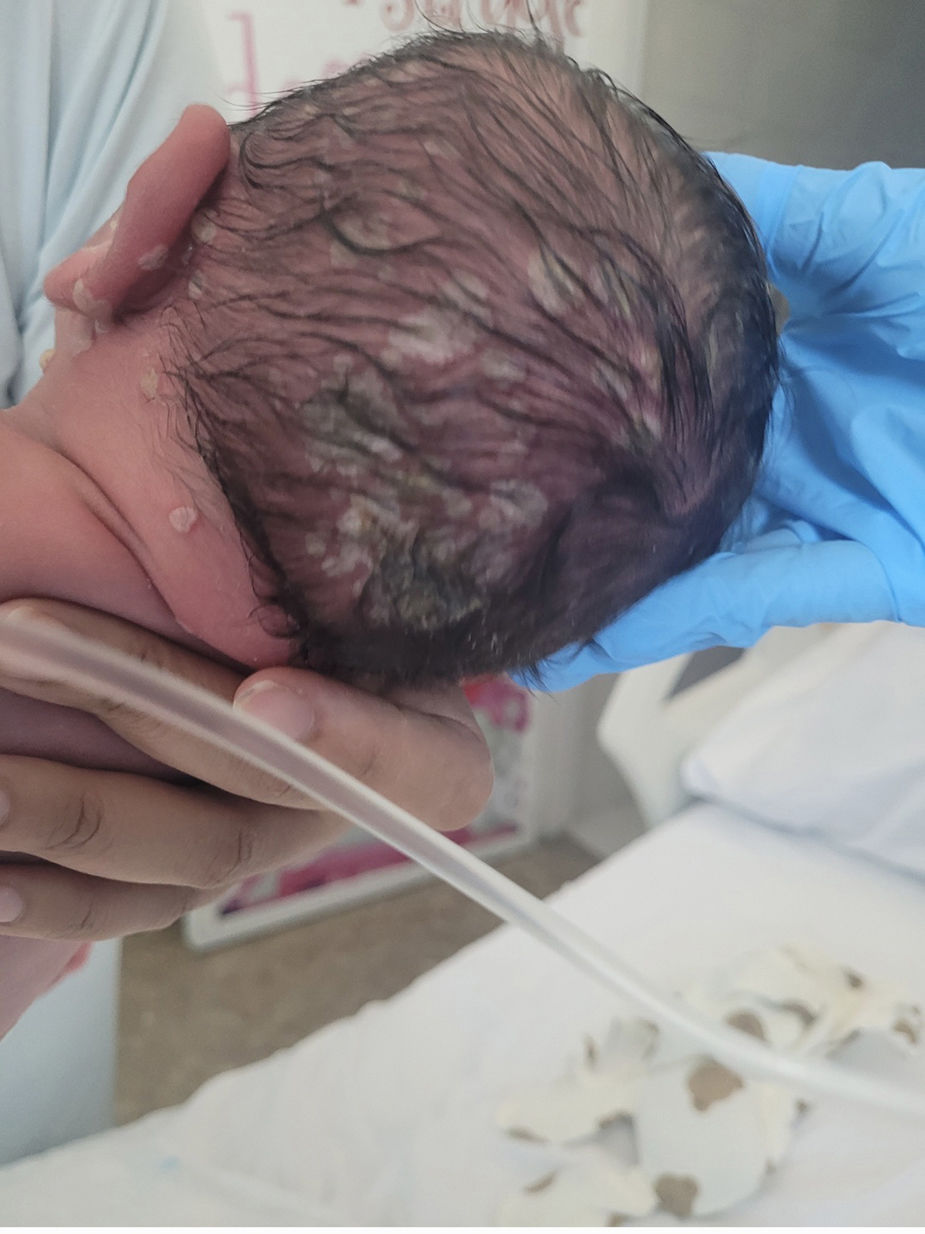
A male infant presented at 8 days of life with progressive vesicular lesions in the face and scalp in absence of other symptoms. The obstetric history was unremarkable. The physical examination revealed vesicular lesions over an erythematous base with a metameric distribution over the scalp, left temporal region and left mandibular ramus (Figs. 1 and 2). The Tzanck smear was positive, while the findings of the blood work, lumbar puncture, transfontanellar ultrasound scan and fundus examination were normal. The patient had a detectable herpes simplex virus type 1 (HVS-1) viral load. Treatment was initiated with acyclovir, delivered intravenously the first 14 days, followed by oral administration for 6 months. The follow-up included a hearing test (normal) and monitoring in the outpatient clinic, with favorable outcomes and no recurrences. The incidence of neonatal infection by HVS is of 1 in 100 000 to 300 000 live births, and in 80% of cases there is no previous history of maternal infection.1 Early initiation of treatment improves patient outcomes.2 The symptoms may be mild or nonspecific, delaying the diagnosis. Polymerase chain reaction (PCR) tests for detection of HVS in lesion, blood, or cerebrospinal fluid samples are available in many centers and allow rapid confirmation. Neonatal herpes requires multidisciplinary management and close monitoring to detect recurrences or complications.2,3

Figure 1.

Crusting vesicular lesions on an erythematous base in the left preauricular area and cervical region, consistent with a metameric distribution.

Figure 2.

Involvement of the scalp with multiple vesicular lesions and crusts on an erythematous base, predominantly in the left occipital region.

Funding

This research did not receive any external funding.

References
[1]
F. Baquero-Artigao, L.M. Prieto Tato, J.T. Ramos Amador, A. Alarcón Allen, M. de la Calle, M.A. Frick, et al.
Grupo de Trabajo de Infección Neonatal por virus herpes simplex de la Sociedad Española de Infectología Pediátrica. The Spanish Society of Paediatric Infectious Diseases guidelines on the prevention, diagnosis and treatment of neonatal herpes simplex infections [Article in Spanish].
An Pediatr (Barc)., 89 (2018), pp. 64.e1-64.e10
[2]
N.L. Samies, S.H. James, D.W. Kimberlin.
Neonatal herpes simplex virus disease: updates and continued challenges.
Clin Perinatol., 48 (2021), pp. 263-274
[3]
D.U. De Rose, S. Bompard, C. Maddaloni, I. Bersani, L. Martini, A. Santisi, et al.
Neonatal herpes simplex virus infection: from the maternal infection to the child outcome.
J Med Virol., 95 (2023),

Meeting presentation: this case was presented as a poster at the XXX Congress of the Sociedad Española de Neonatología; October 22–24, 2025; Las Palmas de Gran Canaria, Spain.


Copyright © 2026. Asociación Española de Pediatría
Descargar PDF
Idiomas
Anales de Pediatría
Opciones de artículo
Herramientas
