

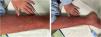
We present the case of an adolescent aged 15 years who experienced fever of three days’ duration, diarrhea and headache. The patient had arrived in Spain from Colombia 24 hours prior to the onset of symptoms. The patient presented to the emergency department on day five from onset, 48 hours after defervescence, with an erythematous rash with interspersed pale blotches and generalized petechiae (Figs. 1 and 2). The complete blood count and chemistry panel did not evince leukopenia or thrombocytopenia, characteristic of dengue, but revealed elevation of alanine transaminase (ALT, 481 U/L) and lactate dehydrogenase (LDH, 603 U/L), commonly found in this disease. The NS1 antigen test and RT-PCR assay for detection of dengue in blood specimens were both negative. Subsequently, antibody tests (ELISA) yielded positive results for IgM and IgG antibodies, compatible with recent infection.

Imported dengue is an emerging arbovirus infection in Spain whose incidence has been increasing in recent years, including in the pediatric population.1 Its characteristic rash, with the appearance of “white islands in a sea of red”, develops one or two days after the resolution of fever and lasts for 5 days. The diagnosis is based on epidemiological, clinical and laboratory criteria (PCR or NS1 antigen test: positive in the first 7-10 days of illness; serology tests: positive result at a later time).2 Given the nonspecificity of its symptoms, in the context of globalization, clinicians must maintain a high index of suspicion for these diseases to rule out the presence of warning signs or predictors of severity (liver failure, shock or hemorrhagic manifestations) requiring prompt intervention.3